


Most educators and parents have heard a student say something like this after a test:
“I swear I knew It when I walked into the room… I don’t know what happened.”
This experience is surprisingly common. Tests are designed to measure whether students have learned the material they were taught. Ideally, a test score reflects mastery of content and the ability to apply knowledge. In reality, however, tests often measure something else as well: how efficiently the brain can manage the cognitive demands of the testing situation itself.
Understanding what happens in the brain during a test reveals why capable students sometimes struggle to demonstrate what they know—and what educators and families can do to help.
Tests Are Cognitive Stress Tests
When students sit down to take a test, their brains must coordinate multiple cognitive systems simultaneously.
A typical test question may require a student to:
- Sustain attention
- Hold information in working memory
- Retrieve previously learned knowledge
- Interpret language or symbols
- Organize multi-step reasoning
- Monitor accuracy
- Manage time pressure
- Regulate stress and emotions
This combination of demands means that tests function as cognitive stress tests. Even when students understand the content, the additional cognitive load can interfere with performance.
Consider a simple math word problem:
A school is planning a field trip. There are 128 students going, 68 girls and 60 boys. Each bus holds 36 students. The school has reserved three buses. Will three buses be enough? If not, how many more buses are needed?
To solve this problem, students must first decode the language, screen out the irrelevant number and identify the relevant numbers, remember the relevant numbers while performing calculations, and keep track of multiple steps. Each of these processes draws on the cognitive resources they bring to the task, often reduced by the impact of being anxious.
In fact, research suggests that 25–40% of students experience test anxiety, and about one in five students experiences anxiety at levels high enough to interfere with performance. But anxiety is only part of the story.
Working Memory Under Pressure
One of the most important cognitive systems involved in testing is working memory—the brain’s ability to hold and manipulate information temporarily.
Working memory allows students to keep track of numbers in a math problem, remember the beginning of a sentence while reading the end, or follow multi-step instructions.
But working memory has limited capacity. Under conditions of stress, that capacity is reduced even further.
When students feel anxious during a test, the brain’s threat-detection system—the amygdala—becomes more active. This triggers physiological responses associated with the “fight or flight” reaction. Because the body is redirecting its resources to help us run away from danger, the prefrontal cortex, which supports reasoning and working memory, becomes less efficient.
The result is a familiar experience: students feel as if their minds have gone blank.
The knowledge is still stored in long-term memory, but the pathway to retrieve it has become temporarily blocked by stress and cognitive overload.
Processing Speed and Time Pressure
Another important factor in test performance is processing speed—the rate at which the brain can interpret information and respond.
Most classroom tests are timed. Students must read questions, interpret them, plan solutions, and produce answers within a limited period.
Students with slower processing speed may fully understand the material yet struggle to finish a test on time. As time pressure increases, cognitive load accumulates. Fatigue sets in, accuracy declines, and students may rush through the final portion of the exam.
It is important to emphasize that slow processing speed is not the same as low intelligence. Many highly capable students simply require more time to work through complex information.
Study Habits That Hurt Performance
Some of the most common study habits used by students are surprisingly ineffective when viewed through the lens of cognitive science.
For example:
Cramming.
Massed studying shortly before a test creates familiarity with material but does not strengthen long-term memory. It also increases stress and often disrupts sleep—both of which undermine performance.
Passive review.
Rereading notes or textbooks may feel productive, but it relies on recognition rather than retrieval. Recognition is far less demanding than retrieving and thinking about information and does little to strengthen the connections in the brain where information is stored. Information that is coded so superficially, just won’t stand up to the test.
Reviewing everything equally.
Students frequently spend time reviewing material they already know rather than focusing on areas of uncertainty. These habits create the illusion of learning without strengthening the neural pathways required for reliable recall.
Strategies That Actually Help
Research on learning and memory suggests several strategies that improve both retention and test performance.
Retrieval Practice
One of the most effective learning techniques is retrieval practice—actively recalling information rather than simply reviewing it. Frequent low-stakes recall strengthens neural pathways, making information easier to retrieve later. Flash cards, practice quizzes, and explaining concepts aloud are all examples of retrieval practice.
Spaced Practice
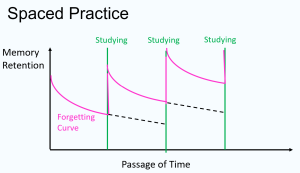
Learning is more durable when study sessions are spread over time. Known as spaced practice, this approach allows memory traces to strengthen through repeated reactivation.
Each review slows the rate at which information is forgotten, gradually flattening the “forgetting curve” as depicted in the following image.
Practice Under Test Conditions
Simulating test conditions can also improve performance. Timed practice sessions help students develop a sense of pacing, build cognitive endurance, and reduce the novelty of the testing environment. When a situation feels familiar, it is less likely to trigger stress responses.
Sleep
Sleep plays a critical role in learning. During sleep, the brain consolidates memories, clears metabolic waste, and restores executive functions needed for reasoning and attention. Students who sacrifice sleep to study often experience the opposite of the intended effect: weaker memory and poorer performance.
Managing Stress During Tests
Some degree of anxiety is normal and even beneficial. A small amount of stress increases alertness and motivation. However, when anxiety becomes excessive, it interferes with cognitive performance.
Simple strategies can help regulate the stress response:
- Slow breathing to activate the parasympathetic nervous system
- Writing down worries before a test to reduce intrusive thoughts
- Brief relaxation routines that restore focus
These techniques do not eliminate anxiety, but they can prevent it from overwhelming the cognitive work of taking a test.
Strategic Test-Taking
Certain practical strategies can also reduce cognitive load during exams.
Students benefit from:
- Writing key information in the margin so it does not have to be held in working memory
- Scanning the test first and planning how to allocate time
- Starting with easier or higher-value questions to build momentum
- Skipping difficult items temporarily and returning later if time allows
- Reading questions before passages in comprehension sections to guide attention
These strategies free cognitive resources for reasoning rather than memory management.
Looking Beyond Test Scores
Repeated patterns during testing can provide clues about underlying cognitive challenges.
Students who consistently:
- run out of time
- blank under pressure
- make frequent “careless” mistakes
- or fatigue before finishing
may not be struggling with motivation or effort. Instead, these patterns often reflect cognitive capacity constraints.
Strengthening core cognitive skills—such as working memory, attention control, processing efficiency, and cognitive flexibility—can improve both learning and test performance.
A Broader Perspective on Testing
Tests will likely remain a central feature of education. But understanding the cognitive processes involved in test performance allows educators and parents to interpret results more accurately.
A low test score does not always indicate that a student failed to learn the material. Sometimes it reflects the brain’s difficulty managing the complex cognitive demands of the testing situation.
When we recognize the role of cognitive skills in learning, we can move beyond simply preparing students for tests and instead focus on building the mental capacities that support learning itself.
And when those capacities grow, students are better able not only to succeed on tests—but to become confident, capable learners.


